Struggling to focus on any one thing for any prolonged period of time this week. I keep flitting from task to task, which means I’ve just got a heap of half-finished bits and pieces in front of me. In an attempt to corral my skittish tendencies by forcing myself to actually finish One Damn Thing today, I’m putting on my crown as The King of Displacement Activity to bang out a blogpost, as I herald the entirely-unplanned return of The Full Clip, a collection of things I've tripped across on the internet when I really should be doing something else. Here we go...
At Buzzfeed (I know, shut up), Mark Slutsky talks about his blog Sad YouTube, which curates and preserves the stray shards of heartfelt and personal anecdotes buried in the slurry of comments under YouTube videos. We’re so used to the tedious accepted narrative that Reader Comments Are Sick And Wrong, and that’s demonstrably untrue. Sure, comment sections are the global water colour for loons of every stripe but, honestly, we’re all adults here. It’s easy enough to skate past the lunatic ramblings to actually dig deep for the good stuff. In Slutsky’s words: “It’s a repository of memories, stories, and dreams, an accidental oral history of American life over the last 50 years written by the site’s millions of visitors every day.” Read the rest in his article Sad YouTube: The Lost Treasures Of The Internet’s Greatest Cesspool.
Over at her blog, Sarah Werner eloquently skewers the likes of @HistoryInPics and similar twitter streams that churn out “vintage” photos, frequently with little or no context, attribution, citation or accuracy. “These accounts capitalize on a notion that history is nothing more than superficial glimpses of some vaguely defined time before ours, one that exists for us to look at and exclaim over and move on from without worrying about what it means and whether it happened.” It really is worth clicking through to read the rest of it: It’s History, Not A Viral Feed.
It only came to my attention the other day that jazz guitarist Ronny Jordan had recently died. I remember seeing him play a terrific set at Ronnie Scott’s back in the day, and fans of The West Wing undoubtedly cherish the scene where C.J. Cregg performed The Jackal. Of all his songs, that’s the one I return to the most often. Here’s an obituary at The Guardian and here, one more time, is The Jackal:
On a lighter note, check this out. In the 2015 of Back to the Future Part II, Marty McFly is briefly menaced by a lurching hologram that attacks him as part of an advertisement for Jaws 19, directed by Max Spielberg. In 2014, we still haven’t got any further than Jaws: The Revenge (the fourth film in the series and the one that killed the franchise stone dead). So we’re still fifteen Jaws sequels away from the world glimpsed in the Hill Valley of 2015. But, history can still change...A fan has issued a call-to-arms to cobble together another fifteen Jaws sequels before October 21st 2015. Read more about this glorious folly here, and good luck to him: The Jaws 19 Challenge.
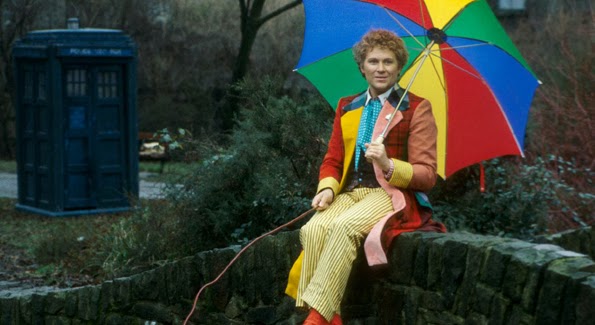
One last thing: Peter Capaldi is The Doctor. David Tennant riffed on Peter Davison. Matt Smith travelled through time and space in the wake of Patrick Troughton. And Capaldi? I think we all know Who he likes the best…
Reverse the polarity! Here's hoping he can bust out some Venusian Aikido too.
There’s no getting away from it. The New Year has begun, and I find that sometimes it helps to clarify my approach to the next twelve months with some sort of Statement of Intent. This year, I will be hewing closely to the words of the prophet Jerry Reed:
Yes, for 2014, I will be adopting the Bandit as my spirit animal. I've got a long way to go and a short time to get there. Just watch ol’ AKA run.
Keep your foot hard on the peddle...Son, never mind them brakes...
I really wasn't intending to write another blog post this year. And I certainly wasn't planning on doing a "Best of the Year" list. But in my idle moments, my mind shuffled a list together without my explicit permission. Damn brains. They never do what they're told.
I promise you, right now, that every single thing in this blogpost will appear on this one single, solitary page. You won’t have to click “Next” to go to another page for an infinitesimally small portion of more “content”. Only bastards with contempt for their readers would do that.
(“Integrity with a growl”. I should put that on some business cards.)
(There will be occasional, optional referrals to other pages of Cool Older Shit and I make no apologies for those.)
(Also: Nothing that appears on this blog is “content”. Ever.)
Not doing a list this year. I did think about it. But, honestly, shuffling films into some sort of “this is better than that” hierarchy is a massive, meaningless, time-consuming and ultimately fruitless endeavour / ballache. So, I’m just going to rap a while about the things that I dug in 2013 in no particular order. Although there were five films that towered above all others for me this year. So I’ll start here, with:
Pablo Larraín’s No - A two-pronged celebration of both the outcome of Pinochet's 1988 plebiscite in Chile and the grungy lo-fi joys of U-matic videotape. Just glorious.
Drug War - I love everything that Johnnie To does, so you won’t find me wheeling out hackneyed phrases like “return to form” here. An exhilarating police procedural that is as hugely entertaining as it is, ultimately, bleak. Imagine To's PTU shot through with the sensibility of David Simon's The Wire.
Paulo Sorrentino trained his camera on The Great Beauty of Rome and the expressive crevasses of Toni Servillo’s swaggering, insouciant, hangdog face in this magnificent film that plays like Antonioni’s La Notte spiked with a hypodermic of Lynchian dissonance.
Those were the five standouts, but there were some other moments that have continued to percolate insistently in the last year:
Both Warm Bodies and Oblivion reassured me that, regardless of your apocalyptic flavour of choice, when the end of the world comes, we’ll all go back to listening to vinyl.
The most sensual moment of Blue is the Warmest Colour is fully-clothed - bolognese sauce smeared clumsily across Adèle’s lips as she devours a family meal. A manipulative, exhausting, intimate, intense and enthralling film where nothing feels like a performance - it feels more like eavesdropping or voyeurism. Adèle Exarchopoulos's open, raw vulnerability in particular is extraordinary.
I've said it before and I'll say it again: Nicolas Winding Refn is essentially a gifted trickster plagiarist. With Only God Forgives, Refn raids his DVD collection and appropriates his favourite cinematic surfaces (Chris Doyle & Wong Kar Wai; Noé; Cronenberg; Park Chan-wook; Lynch; Argento; Carpenter) but forgoes substance. It isn't a bad film - it's just very irritating and ultimately it isn't about anything. It's all just a pose. Refn is having a WongKarWank. However, the moment where Kristin Scott Thomas casually tosses off the insult “How many cocks can you entertain with that cute little cum-dumpster of yours?” will stay with me for some time...
I was one of the few people happy to see Walter Hill back on the big screen with Bullet to the Head, even if it is just a minor footnote to an amazing body of work. Turns out they do make 'em like they used to. Racial tension, bar brawls and gun fights, all shot through with Hill’s preoccupation with tenacious, brutally-efficient men. “Kinda fun, isn't it? Just you and me, two professionals, only one gets away.”Bullet to the Head makes for a solid triptych with 48 Hrs. and Red Heat. Welcome back, Walter. Don't stay away so long next time, OK?
Quentin Tarantino returned for another rip-roaring rampage of revenge with Django Unchained, a film peppered with memorable moments in the tradition of Howard Hawks ("A good movie is three good scenes and no bad scenes."). From the sight of Dr. King Schultz’s wobbly tooth wagon riding into town, to the immensely satisfying moment when Django utters the endlessly quotable “I like the way you die, boy”, to the scene where Leonardo DiCaprio’s Calvin Candie slams his hand down on the table against a crystal glass, gashing it open. Unplanned, unscripted and entirely unintentional, no-one breaks character as the blood begins to pour.
Other notables that gave me great pleasure this year include the realisation of all my 8-bit dreams writ large in Wreck-it-Ralph and the woefully-underseen and entirely magnificent The Kings of Summer. And the only real fault I can find with Pacific Rim is that terrible, unrepresentative title, which only evokes watery anilingus.
Two films that I seem unable to separate in my memory are Stoker and The Paperboy, straddling both sides of American Gothic a little bit like Nicole Kidman straddling Zac Efron to see if that hoary old chestnut about pissing on a jellyfish sting is true. Stoker comes at things from the chilly, clinical razor-sharp outsider’s perspective of Park Chan-wook, whereas The Paperboy roots around in the dirt in all its sweaty, lustful, grimy squalor. (And I heartily recommend taking a look at Park’s process in staging the spider scene in Stoker via his storyboards here).
A look back at the year would be lacking somewhat without two squat yellow dildo-shaped things giggling uncontrollably over the word "bottom". Over to you, Despicable Me 2:
My highpoints in the head-cracking, explodo stakes included Nick Frost busting out the bar-stools at The World’s End, the President of the United States accidentally dropping a rocket-launcher in the middle of a car chase on the White House lawn in White House Down, and the sight of Mjölnir navigating the curves and corners of London searching for its master in Thor The Dark World.
Ron Howard’s Rush was a blast and is a fine companion piece to Asif Kapadia’s Senna. The real star of Rush is the sound design. Second billing goes to Anthony Dod Mantle's cinematography. In third place, Daniel Brühl. And whoever decided not to have Russell Crowe cameo as Richard Burton (as rumoured) deserves an Executive Producer credit.
It was a fine year for the London Film Festival too. Keep a look out in 2014 for the documentary Jodorowsky’s Dune, in which Jodo recruits a crew of spiritual warriors (including Moebius, HR Giger and Chris Foss) to dream a film that reverberated through the future of science-fiction cinema for almost forty years and counting. And it never even got made. Heartening, beautiful, funny and even occasionally awe-inspiring.
Another LFF treat was Hélène Cattet and Bruno Forzani’s The Strange Colour of Your Body’s Tears, a gorgeous, gloriously opaque giallo (or should that be "jaune"?) that was enhanced by the fact that the house curtains accidentally closed five minutes before the end, resulting in the projection of the denouement directly onto the curtains, adding an additional layer of woozy unreality. My initial impression (and this is a film that requires far more than just one viewing): Berberian Studio Apartment.
Loath as I am to talk trash about stuff I didn't like, sometimes I've just got to be that guy. The Most Heinous Piece of Shit award goes to V/H/S, which I've already griped about enough for one lifetime. To revisit that particular tirade, click here.
Runner-Up: Frances Ha. I know a lot of people like this sort of thing, but I’ll never, ever get it. Because I just don’t see the appeal of wallowing in the grumbles and gripes of self-entitled middle-class white people. (You know, every time I hear the theme tune from Friends, I want to stick my fist through a TV screen.) Frances Ha is a Greta Gerwig film where, for a change, Greta Gerwig plays the least irritating character. This isn't an endorsement. I just don't get the whole Greta Gerwig thing at all. She just seems to be Zooey Deschanel 2.0.
I didn’t like Man of Steel much at all. A Superman film can be a lot of things, but I don't think "joyless" and "humourless" should be two of them. Smeared with a grim, bleached-out colour palette, and spectacle that indicates that the visual effects of 1978 are superior to those of 2013, it's jarring to watch a film that clearly cost a lot of money, yet makes an effort to look so grubby and cheap. That effect that looks like a camera pulling focus on CG objects that aren't there? I don't like it. The saddest thing about Man of Steel for me is that it seems embarrassed and apologetic about being a superhero movie. Embrace the hyper-reality & absurdity! Yet, having said all of that, there is one moment that I just can’t shake: Jonathan Kent (Kevin Costner) taking one last proud, wistful look back at his son Clark before disappearing into the eye of the storm. But I think that probably says more about me than about the film. Have at thee, Jungians!
A foggy night in London, fifty years ago today. A policeman on his evening patrol passes by a building with a sign outside that reads: "I.M. Foreman, Scrap Merchant, 76 Totter's Lane". Inside, all manner of rubbish is strewn across the floor. And in the corner, there's a blue police telephone box. At least, it's something that looks like a police telephone box.
Let the Adventures in Space and Time commence! Today, the single most important piece of serial fiction in my life is fifty year's old. Happy Birthday, Doctor. You don't look a day over 906.
Splendid chaps. All of them.
"I Tolerate This Century, But I Don't Enjoy It"
"There are some corners of the universe which have bred the most terrible things. Things which act against everything we believe in. They must be fought."
"Courage isn't just a matter of not being frightened, you know. It's being afraid and doing what you have to do anyway."
"Well, of course I'm being childish! There's no point being grown-up if you can't be childish sometimes."
"There's always something to look at if you open your eyes!"
"Rest is for the weary, sleep is for the dead. I feel like a hungry man eager for the feast!"
"There are worlds out there where the sky is burning, and the sea's asleep, and the rivers dream; people made of smoke and cities made of song. Somewhere there's danger, somewhere there's injustice, and somewhere else the tea's getting cold. Come on, Ace. We've got work to do."
"I love humans. Always seeing patterns in things that aren't there."
"Nine hundred years of time and space, and I've never been slapped by someone's mother."
"I'm the Doctor. I'm a Time Lord. I'm from the planet Gallifrey in the constellation of Kasterborous. I'm 903 years old, and I'm the man who's gonna save your lives and all six billion people on the planet below. You got a problem with that?"
"Amy Pond, there's something you better understand about me 'cause it's important and one day your life may depend on it...I am definitely a mad man with a box."
"I've seen whole armies turn and run away. And he'd just swagger off, back to his TARDIS. And open the doors with a snap of his fingers. The Doctor. In the TARDIS. Next stop: Everywhere." UPDATED: Because I really wanted to capture all thirteen:
Another month passes, and October has seen me thrashing about deep in the word-weeds elsewhere, so the blog has lain fallow. To keep things ticking over, this is a "Proof of Life" post, replete with an image dump of the stuff I've yanked from the Internet in my rare idle moments for multifarious reasons, under the catch-all header "Research". Yes, this is a visual manifestation of the slurry inside my head:
Elmore Leonard died on Tuesday. Stories and memorials have been appearing everywhere since. This one is mine.
It would’ve been 1988. Which would’ve made me sixteen years old at the time. I was on a family holiday in Florida and, as usual, no matter how many books I’d packed to cover the duration, I’d managed to get through them all long before the end of the holiday.
I found myself in the hotel lobby, prodding at a spinner rack of largely uninspiring paperbacks. But there was one book that stood out from the slabs of Tom Clancy and Jackie Collins. This was the cover:
So I bought it. I found a quiet corner, cracked open the cover, and this is what I found on the first page:
Chris Mankowski’s last day on the job, two in the afternoon, two hours to go, he got a call to dispose of a bomb. What happened, a guy by the name of Booker, a twenty-five-year-old super-dude twice-convicted felon, was in his Jacuzzi when the phone rang. He yelled for his bodyguard Juicy Mouth to take it. “Hey, Juicy?” His bodyguard, his driver and his houseman were around somewhere. “Will somebody get the phone?” The phone kept ringing. The phone must have rung fifteen times before Booker got out of the Jacuzzi, put on his green satin robe that matched the emerald pinned to his left earlobe and picked up the phone. Booker said, “Who’s this?” A woman’s voice said, “You sitting down?” The phone was on a table next to a green leather wingback chair. Booker loved green. He said, “Baby, is that you?” It sounded like his woman, Moselle. Her voice said, “Are you sitting down? You have to be sitting down for when I tell you something.” Booker said, “Baby, you sound different. What’s wrong?” He sat down in the green leather chair, frowning, working his butt around to get comfortable. The woman’s voice said, “Are you sitting down?” Booker said, “I am. I have sat the fuck down. Now you gonna talk to me, what?” Moselle’s voice said, “I’m suppose to tell you that when you get up, honey, what’s left of your ass is gonna go clear through the ceiling."
And that was it. I was in love. I tore through that sucker in a day.
Sometimes, you find a book or an author who re-wires the way you think about stories and language. Elmore Leonard was the one that did it for me. It read like the work of a man who enjoyed writing, and wanted you to enjoy reading it just as much.
Once I got back to London, I went on the hunt for his previous books. Fortunately for me, 1988 was also the year that Murder One opened on Charing Cross Road. I’d buy as many as I could afford whenever I went in there and began to scarf them down on the Tube journey home.
And when I’d exhausted his backlog of crime stories, I started in on the westerns. Then the short stories. I was a little bereft when I’d finally got through them all. But I knew that a new one was never very far away.
I continued picking up new volumes whenever they came out. Then, life got in the way and I’ve realised that the last Elmore Leonard book I read is Up in Honey’s Room, and that was back in 2009. The upside to that is I’ve still got some books to read. (Top of my To-Do List: get hold of copies of Road Dogs, Djibouti and Raylan). The downside...well, you know the downside.
The narrative trajectory of Gore Verbinski’s embattled The Lone Ranger goes a little something like this: Years of news about production shutdowns and budgetary concerns. Fast forward to a slew of largely terrible reviews in the US. “Underperforming” or “a bomb” at the box office, depending on the argot of your media outlet of choice. Hell, even Disney couldn't wait to throw clods of dirt on the still-warm corpse, burying it in the same grave as the wormy remains of it’s similarly-neglected sibling John Carter.
Well, I’m here to say: Forget all of that. None of it matters. The only thing that matters is the 149 minutes of film on the screen. And what I saw was exhilarating, smart, funny, strange, ambitious, beautiful, joyous, poetic and hugely satisfying. Don't believe the bad hype for a second. Instead, here are just some of the reasons why The Lone Ranger is much, much better than you've been (mis)led to believe:
The Lone Ranger is a timely, savage indictment of the lengths America will go to in the name of “progress” (without being portentous or heavy-handed about it). Laws are trifling inconveniences that can be neatly side-stepped with the right pay-off, the right threat or the right bullet. Genocide is an acceptable cost for the acquisition of more power, more money, more more more. The film is populated with lawmen, politicians, power-brokers and soldiers who fall into two camps: the tiny subset of honest ones that need to be eliminated and the larger group that can be bought and corrupted with the promise of riches. At last! A big bold blockbuster that’s actually about something! The Lone Ranger, which has understandably been described in some quarters as un-American, is one of the finest American films of the year. And yet I assure you, it isn't preachy or tub-thumping in the slightest. It’s a helluva lot of fun.
There’s a glorious seam of the strange and surreal threaded in and out of The Lone Ranger. Verbinski has hurled healthy servings of the inexplicable and the unusual in to his work before to varying degrees of success, from the hallucinations of Captain Jack Sparrow in Davy Jones’ Locker in the otherwise tedious and lumpen Pirates of the Caribbean: At World’s End, to the skewed aura of discomfiting bleakness that hangs over the underrated The Weather Man and the sublime weirdness that permeates Rango. (I've struggled and failed to find a place for a Lone Rango pun in this blogpost. So I’ll just leave it here for safekeeping).
The Lone Ranger is a film that contains a time-travelling sack of peanuts. Vampiric, carnivorous bunnies. Schrödinger's crow. If that isn't enough to pique your interest, then I’m at a loss to understand what the hell people want from a summer blockbuster these days. This isn't yet another bloated iteration of the same generic stories that you've already seen so many times before. On top of that, Verbinski has a puckish approach to chronology and narrative convention. Things sometimes happen without explanation. Well, not totally without explanation - Verbinski has enough of a mischievous sense of fun to hang a lantern on the intentional narrative inconsistencies and ellipses.
And what of the man in the white hat himself? This year, even the red, white and blue Superman has blood on his hands, but here we get an American hero who agonises over and avoids brutality and death as much as humanly possible, spurning the wafer-thin compromises of the law and embracing his unshakeable sense of justice in order to meet his destiny. “If these men represent the law, I'd rather be an outlaw”.
Right. Let’s tackle a common criticism of The Lone Ranger that even some of the film’s supporters level at it: that it’s too long. I hew to Roger Ebert’s maxim that “No good movie is too long and no bad movie is short enough.” The Lone Rangerdoesn't seem too long to me at all - it seems just as long as it needs to be. I can’t think of anything in there that I would consider padding. If anything, there are elements that could have used a little bit more room to breathe, like Helena Bonham Carter’s slightly underwritten role. I’d imagine this criticism largely stems from the fact that Verbinski shuns the quick-cutting, restless edits that renders so many contemporary action sequences incomprehensible. Thankfully, Verbinski is a director unafraid of a long take or a lingering camera. (I've come to the conclusion that, increasingly, the Michael Bay “fucking the frame” mode of How To Cut Action has become de rigeur to hide shonky digital effects work. But that’s a discussion for another time).
For a bit of context and comparison, these are the running times of my three favourite westerns:
Rio Bravo - 141 minutes
The Wild Bunch - 145 minutes
Once Upon a Time in the West - 175 minutes
Those comparisons are useful, actually, for The Lone Ranger aims to achieve a level of verisimilitude (and when I say “verisimilitude”, I don’t mean that the film strives to accurately recreate the Old West. I mean that it strives to evoke old Westerns.) Every beautifully composed shot of Monument Valley recalls John Ford. Every close-up of a leering, ravaged, sweaty face references Sergio Leone. The Lone Ranger deftly strikes just the right balance between the sun-dappled vistas and dusty prairies of Ford with the murkier moral landscape of Leone. And Leone is probably Verbinski’s most overt, deliberate touchstone here. Once Upon a Time in the West exerts the strongest influence on The Lone Ranger and, for me at least, this is A Very Good Thing Indeed.
Think about other relatively recent attempts at a crowd-pleasing western. Shanghai Noon is fun, but lightweight. Wild Wild West is lightweight and really not very much fun at all. The Lone Ranger is not in the tradition of those films, which are essentially westerns for people who don’t like westerns. Crucially, the CGI in The Lone Ranger is at a minimum and, when there is a bit, it’s seamless and invisible, which is what all good CGI should be. It should be a minor enhancement, not a substitute. Real horses. Real trains. Stunts and chases and shoot-outs with weight and heft and consequences and honest, well-earned thrills. The Lone Ranger takes us through Death Valley without plunging us into the uncanny valley. Slap the William Tell Overture over the top of that and, goddamn, that’s a good time at the movies.
One last thing: If I've managed to persuade you to take a chance on The Lone Ranger, then make sure you stay in your seat for a truly lovely parting shot that unfolds slowly over the end credits.