Tuesday, August 20, 2013

Justice Is What I Seek - Avenging The Lone Ranger


The narrative trajectory of Gore Verbinski’s embattled The Lone Ranger goes a little something like this: Years of news about production shutdowns and budgetary concerns. Fast forward to a slew of largely terrible reviews in the US. “Underperforming” or “a bomb” at the box office, depending on the argot of your media outlet of choice. Hell, even Disney couldn't wait to throw clods of dirt on the still-warm corpse, burying it in the same grave as the wormy remains of it’s similarly-neglected sibling John Carter.

Well, I’m here to say: Forget all of that. None of it matters. The only thing that matters is the 149 minutes of film on the screen. And what I saw was exhilarating, smart, funny, strange, ambitious, beautiful, joyous, poetic and hugely satisfying. Don't believe the bad hype for a second. Instead, here are just some of the reasons why The Lone Ranger is much, much better than you've been (mis)led to believe:


The Lone Ranger is a timely, savage indictment of the lengths America will go to in the name of “progress” (without being portentous or heavy-handed about it). Laws are trifling inconveniences that can be neatly side-stepped with the right pay-off, the right threat or the right bullet. Genocide is an acceptable cost for the acquisition of more power, more money, more more more. The film is populated with lawmen, politicians, power-brokers and soldiers who fall into two camps: the tiny subset of honest ones that need to be eliminated and the larger group that can be bought and corrupted with the promise of riches. At last! A big bold blockbuster that’s actually about something! The Lone Ranger, which has understandably been described in some quarters as un-American, is one of the finest American films of the year. And yet I assure you, it isn't preachy or tub-thumping in the slightest. It’s a helluva lot of fun.

There’s a glorious seam of the strange and surreal threaded in and out of The Lone Ranger. Verbinski has hurled healthy servings of the inexplicable and the unusual in to his work before to varying degrees of success, from the hallucinations of Captain Jack Sparrow in Davy Jones’ Locker in the otherwise tedious and lumpen Pirates of the Caribbean: At World’s End, to the skewed aura of discomfiting bleakness that hangs over the underrated The Weather Man and the sublime weirdness that permeates Rango. (I've struggled and failed to find a place for a Lone Rango pun in this blogpost. So I’ll just leave it here for safekeeping). 

The Lone Ranger is a film that contains a time-travelling sack of peanuts. Vampiric, carnivorous bunnies. Schrödinger's crow. If that isn't enough to pique your interest, then I’m at a loss to understand what the hell people want from a summer blockbuster these days. This isn't yet another bloated iteration of the same generic stories that you've already seen so many times before. On top of that, Verbinski has a puckish approach to chronology and narrative convention. Things sometimes happen without explanation. Well, not totally without explanation - Verbinski has enough of a mischievous sense of fun to hang a lantern on the intentional narrative inconsistencies and ellipses. 

And what of the man in the white hat himself? This year, even the red, white and blue Superman has blood on his hands, but here we get an American hero who agonises over and avoids brutality and death as much as humanly possible, spurning the wafer-thin compromises of the law and embracing his unshakeable sense of justice in order to meet his destiny. “If these men represent the law, I'd rather be an outlaw”. 


Right. Let’s tackle a common criticism of The Lone Ranger that even some of the film’s supporters level at it: that it’s too long. I hew to Roger Ebert’s maxim that “No good movie is too long and no bad movie is short enough.” The Lone Ranger doesn't seem too long to me at all - it seems just as long as it needs to be. I can’t think of anything in there that I would consider padding. If anything, there are elements that could have used a little bit more room to breathe, like Helena Bonham Carter’s slightly underwritten role. I’d imagine this criticism largely stems from the fact that Verbinski shuns the quick-cutting, restless edits that renders so many contemporary action sequences incomprehensible. Thankfully, Verbinski is a director unafraid of a long take or a lingering camera. (I've come to the conclusion that, increasingly, the Michael Bay “fucking the frame” mode of How To Cut Action has become de rigeur to hide shonky digital effects work. But that’s a discussion for another time).

For a bit of context and comparison, these are the running times of my three favourite westerns:
Rio Bravo - 141 minutes
The Wild Bunch - 145 minutes
Once Upon a Time in the West - 175 minutes

Those comparisons are useful, actually, for The Lone Ranger aims to achieve a level of verisimilitude (and when I say “verisimilitude”, I don’t mean that the film strives to accurately recreate the Old West. I mean that it strives to evoke old Westerns.) Every beautifully composed shot of Monument Valley recalls John Ford. Every close-up of a leering, ravaged, sweaty face references Sergio Leone. The Lone Ranger deftly strikes just the right balance between the sun-dappled vistas and dusty prairies of Ford with the murkier moral landscape of Leone. And Leone is probably Verbinski’s most overt, deliberate touchstone here. Once Upon a Time in the West exerts the strongest influence on The Lone Ranger and, for me at least, this is A Very Good Thing Indeed. 

Think about other relatively recent attempts at a crowd-pleasing western. Shanghai Noon is fun, but lightweight. Wild Wild West is lightweight and really not very much fun at all. The Lone Ranger is not in the tradition of those films, which are essentially westerns for people who don’t like westerns. Crucially, the CGI in The Lone Ranger is at a minimum and, when there is a bit, it’s seamless and invisible, which is what all good CGI should be. It should be a minor enhancement, not a substitute. Real horses. Real trains. Stunts and chases and shoot-outs with weight and heft and consequences and honest, well-earned thrills. The Lone Ranger takes us through Death Valley without plunging us into the uncanny valley. Slap the William Tell Overture over the top of that and, goddamn, that’s a good time at the movies.

One last thing: If I've managed to persuade you to take a chance on The Lone Ranger, then make sure you stay in your seat for a truly lovely parting shot that unfolds slowly over the end credits.

Tuesday, July 23, 2013

It Came From The Archives! - Kinji Fukasaku’s Battle Royale

Almost exactly a decade ago, I submitted a 4,000 word treatise on Kinji Fukasaku’s Battle Royale for publication in the Wallflower Press book 24 Frames - The Cinema of Japan and Korea. That book has now been out-of-print for some time. I occasionally stumble upon a stray copy in a bookshop, and a trawl around the internet indicates that copies of the book are now swapping hands for around double the cover price. As I've mentioned on the blog before, most of the book is available online thanks to Google Books (including another chapter written by me - an essay on Seijun Suzuki’s Branded to Kill). But my piece on Battle Royale hasn't been readily available for a while. Until now... 
When Battle Royale was first unleashed theatrically outside it’s native Japan, film journalists in the west reached for the same handful of pop cultural touchstones as a kind of comparative critical shorthand to describe it: the reality TV show Survivor; two novellas written by Stephen King (under his pseudonym Richard Bachman), The Long Walk and The Running Man, the
latter adapted as a 1987 Arnold Schwarzenegger vehicle directed by Paul Michael Glaser; and, cited as the most obvious antecedent and frequent comparison, William Golding’s novel The Lord of the Flies.

The fact that comparisons are so easy to reel off says something about the “high concept” of Battle Royale, based on Takami Koushun’s successful 1999 novel of the same name. The Hollywood “high concept” approach of pitching a story in less than thirty seconds, in a way that an audience can grasp without having to even think about it, was popularised by the powerhouse partnership of producers Don Simpson and Jerry Bruckheimer in the 1980s. But “high concept” was an approach so simple (and, arguably, simplistic) that it was never destined to be restricted to the North American continent. The plot of Battle Royale can be pitched in a sentence: “A class of junior-high school students are taken to a deserted island to take part in a game where they must kill one another until only one survivor remains.”

Although this is a hook that can irresistibly reel in potential cinemagoers with ease, it doesn't even begin to encompass the myriad levels the film encapsulates and Fukasaku Kinji’s 2000 film is a far richer, deeper and more rewarding piece of work than its cultural predecessors listed above. In addition to being an exhilarating piece of action cinema in its own right, it takes in satire, allegory, social comment, love story and paranoid thriller, whilst acting as a cautionary tale, with small personal tales of tragedy and friendship buried amidst the gore and entrails.

The opening scenes of Battle Royale immediately introduce both the tone and the themes of the film. Following the brief image of raging waters slamming against rocks off the coast of an island, with a bombastic classical score thundering in the foreground, Fukasaku swiftly cuts to some expository text that informs the viewer that this story takes place in an alternate present. The text, music and imagery give the film the grand texture of much-loved epic series, like the Star Wars saga. The devoted and fanatical cult following that Battle Royale has gained over time since its release is not dissimilar to the adoration and devotion that has been dedicated to the worlds of George Lucas and J. R. R. Tolkien.

At the dawn of the millennium, Japanese society has suffered a severe economic collapse, leading to widespread youth apathy and 800,000 students boycotting school. Adult society sought to reassert their authority by passing the Millennium Education Reform Act, otherwise known as the BR Act. The brief introduction gives way to manic shots of news crews and army troops converging at the end of the previous year’s Battle Royale, before we see flash cuts of the game’s winner: the demonic smile on the cherubic face of a sweaty and blood-spattered little girl hugging an equally bedraggled toy doll. The image is both comic and horrific in equal measure, in much the same way as the action yet to come. 

Next up is a school photograph of Class B of Zentsuji Middle School. The first face the camera focuses upon, significantly, is that of the class teacher Kitano, played by writer, director, painter, actor, comedian and Japanese cinema icon, Kitano Takeshi. The Kitano character is the only major digression from Takami’s source material. In the novel, the character is a stranger to the students of Class B, a government employee called Sakamochi. He is a hateful authority figure with no redeeming qualities whatsoever. In Fukasaku’s adaptation, however, Kitano is their embittered and cynical former class teacher, with a fully realised back story: his relationship with his own daughter is rapidly deteriorating; he has suffered at the hands of the students, particularly Kuninobu Yoshitoki who once stabbed him in the buttocks; and he has a soft spot for Nakagawa Noriko, as evidenced by the way he sits chomping away on her home-made cookies, and later shields her with an umbrella in the midst of the game to protect her from the rain. By casting such a recognisable star in the crucial role of Kitano, the audience hangs on his every word at a time when the information is critical for the viewer, as he deftly handles the always tricky task of delivering exposition in a way that doesn’t feel stilted or artificial. It was also a smart move to give the character the name Kitano, bringing us closer to the iconic figure we recognise from numerous other roles.

By fleshing out the personality of the Kitano character, Fukasaku improves on Takami’s one-dimensional comic-book villain, and also extends the idea of father figures and the way they shape their children, either consciously or by omission. The next character introduced in Battle Royale is Nanahara Shuya (Fujiwara Tatsuya), who discovers the corpse of his father after he has committed suicide. Scrawled on toilet paper, he reads the words: “Go Shuya! You can make it Shuya!” These words will carry greater significance once the game is underway. The words of Shuya’s voiceover embody the underlying tension and fear between adults and children that runs throughout the film: “I didn’t have a clue what to do and no-one to show me either.” The students of Class B will have to deal with their own insecurities, egos and inexperience in the world of Battle Royale, because no-one, least of all an adult, is going to help them. The adults need the weakness and helplessness of children to give them the feeling (or the illusion) of control and superiority, whilst the disillusioned children crave the guidance and protection of adults.

At other moments in the film, we hear hacker whiz kid Mimura Shinji talk about his activist uncle who taught him how to make bombs and other explosives, tragic hero Kawada Shogo frequently attributes skills he has learned to his father’s experience, and there is Kitano, whose obsession with revenge on the children of Class B merely serves to perpetuate the idea of the failure of adults in their responsibilities, by neglecting his own daughter.

One of the many reasons that Battle Royale has become a film that can be revisited time and time again lies in the fact that it resonates in a variety of ways. At times, the film feels strikingly original and modern; whilst at other times it seems like a refinement, updating and natural progression of the themes and situations familiar throughout the history of Japanese (and international) film and popular culture, whilst simultaneously reflecting genuine concerns about issues afflicting modern society. With this in mind, it is easy to see the way in which Battle Royale acknowledges the past, crystallises the present and warns of the impending future. Consequently, it is no surprise that the original novel was the work of first-time author Takami Koushun, and the film was the sixtieth feature film of 70-year old veteran Fukasaku Kinji, bridging the gap between the preoccupations of Japanese history, and the genuine fears (and hopes) for the nation’s unwritten future.

Bearing in mind that Takami was a student who dropped out of Nihon University’s liberal arts correspondence course programme, before spending five years between 1991 and 1996 working as a writer for the prefectural news company Shikoku Shinbun, it is interesting that his novel had such a significant impact on Fukasaku, particularly the fact that it brought back memories from his early years.

Fukasaku was fifteen years old as the Second World War was drawing to a close. His class was drafted into the war effort, and they found themselves working in a munitions factory. The carnage of the war was still something abstract, something that the teenagers were only aware of from a distance, due to the fact that they were only exposed to Allied air raids that could be avoided. But that was about to change. In July 1945, the classmates were caught in a barrage of artillery fire. Just like the fictitious world Fukasaku would chronicle fifty-five years later, there was barely any chance of escape from violent and messy death. The survivors of the attack used the corpses of their friends as cover, and, after the violence had passed, Fukasaku and his surviving friends were given the task of disposing of the body parts of their former classmates. The revelations Fukasaku’s impressionable mind was subjected to heavily influenced both his worldview and the films he would make during the course of his career. Virtually overnight, Fukasaku developed a deep-rooted hostility and distrust towards adults and authority figures, and the lies they tell their children to control and mould them, as well as a tender sentimentality towards his friends.

This sentimentality comes through frequently throughout Battle Royale. If the film was little more than a series of gruesome and inventive set pieces, it would function as acceptable entertainment and mindless spectacle, but the clearly exhibited feelings of the characters gives the film another dimension. With the exception of the ruthlessly psychotic Kiriyama Kazuo, the pain, confusion and disappointment the students feel is evident throughout. Even the scythe-wielding Souma Mitsuko, who attacks the game with relish, has moments when she comes across as more than just a heartless killer. As we hear in voiceover more than once “I didn’t want to be a loser anymore.”

Battle Royale is a savage indictment of a failed competitive education system, a nation’s disaffected youth, and a proud martial civilisation coughing up blood, punishing the next generation for its own failings. The children of Class B are initially presented as unreachable rebels. They write the words “Taking the day off ‘cause we want to” on the blackboard, and early casualty Nobu spitefully attacks Kitano for no apparent reason. However, we soon see the classmates on the coach that is transporting them to their destiny, laughing, playing and flirting, just like any other group of teenagers the world over. As the game progresses, we see normal teenage behaviour, albeit magnified by the abnormal circumstances. Students harbour secret crushes or petty grudges on classmates, and, in the case of Sugimura Hiroki, he constantly puts himself in peril to fulfill a naïve romantic whim, to find the girl he has a crush on, just so he can tell her how he feels. It costs him his life, as she riddles his body with bullets in a moment of blind panic.

As the coach journey continues, the brightly lit Japanese landscape quickly disappears as the coach enters a dark tunnel, lit only by grimy strip lighting. Playtime is over, and the game is underway.

The game becomes a heightened microcosm of the behavioural traits of children in inhuman circumstances. Their humanity and emotions are raw and exposed. By turns, we feel their anger, fear, paranoia, regret, denial, panic, terror, helplessness and, occasionally, their malice. Tellingly, by removing the normal restrictions of civilised society, these emotions bubble to the surface rapidly. Battle Royale exposes not only the depths of genuine friendship (the unlikely alliance between Shuya, Noriko, and former winner of BR, Shogo), but also the limits of friendship when tested. Class representative Utsumi Yukie attempts to impose structure on the situation by hiding out in a lighthouse with a handful of girls. It starts like a perverse pyjama party, with guard shifts and cooking rosters, giggling and playfulness, but the smallest signs of jealousy and paranoia easily shatter the fragile tranquillity. Add lethal weapons to the cocktail of high emotions, and that’s all it takes to ensure that they all die horribly.

Battle Royale is far less stylised than a great deal of the rest of Fukasaku’s oeuvre. Arguably, the story is strong enough to stand on its own considerable merits, without the need for viewer distraction as a result of directorial grandstanding. Fukasaku, however, attributed the detailed, controlled and largely static style of Battle Royale as a necessity borne out of his young cast’s inexperience, and his frustration with their manzai (interaction). Nevertheless, it is the naturalism and slight awkwardness of the children that lends the film much of its authenticity, and the performances are uniformly strong and generally convincing.

In particular, Fujiwara Tatsuya in the role of Nanahara Shuya has to carry most of the film’s emotional weight, and he acquits himself well. There is a striking difference between Shuya’s innocence and Kawada Shogo’s experience. The man Shogo has become was forged in the crucible of his previous participation in Battle Royale. Shuya, however, is shaped by his feelings of responsibility for Noriko, and the lesson’s about life’s unfairness and its harsh realities as espoused by Shogo.

It is far too easy to fall into the trap of analysing the very real and important issues at the heart of Battle Royale, at the expense of acknowledging that Fukasaku’s film is also an exceptionally entertaining and often hilarious action movie, with moments like the severed head with a hand grenade stuffed into its shocked mouth flying through the air; Kitano’s dry announcements to the children (“It’s tough when friends die on you, but hang in there!”); and the sight of a student with an axe buried deep in the centre of his forehead assuring Shuya that he’s absolutely fine. Without the bursts of odd humour, Battle Royale could potentially be an unpleasant trudge to the finishing line. Battle Royale has a dynamic energy in it, borne from the fact that Fukasaku clearly believes deeply in the subject matter, and the importance of communicating truthfully with Japan’s youth.

The rules of the game (and the film) are simple, and seductively compelling. After a school class are picked randomly and taken to a secret and secluded location (in this particular instance, an island where all the inhabitants have been forcibly evacuated), the rules are explained in two complementary ways. There is the genuinely amusing training video, all dayglo colours, hyperactive MTV-generation host and flashy graphics, and, by contrast, Kitano’s actual demonstration of the reality of the game, resulting in the gruesome deaths of two students. The rules are: each student is fitted with a collar that will track their location, and can be automatically detonated if the wearer tries to remove it or escape from the island. The game will last for three days. If there is more than one person still alive at the end of three days, all the collars will detonate. Portions of the island will become “forbidden zones” at announced intervals. Any contestant remaining in one of the zones after the allotted time will have their collar detonated. Each contestant is provided with food, water, a map, a compass, a flashlight and a weapon, which as Fukasaku illustrates in one of the film’s many moments of gallows humour, can turn out to be anything from Shuya’s virtually useless kitchen pot lid, to the psychopathic Kiriyama’s lethal automatic rifle. As the game commences, a title card flashes up. “The Game Begins. Day One. 1.40am.”

There is a stark contrast between the training video, with the sterile and seemingly innocuous title ‘The right way to fight a Battle Royale, by the BR Act Committee’, and Kitano’s brutal proclamation that ‘Life is a game. So fight for your survival and find out if you’re worth it.’

In the tradition of countless stalk-and-slash horror movies, such as Ridley Scott’s Alien (1979) and John Carpenter’s The Thing (1982), Battle Royale works on the most basic level as a film where the viewer remains genuinely curious to see the creative ways the students will viciously dispose of their classmates, and to find out who will be the last man standing. And as a satire of the public’s terrifying blood lust and appetite for the humiliation and suffering of complete strangers, as well as the way both the media and the government blur the lines between entertainment and propaganda, in order to keep the masses docile and distracted, the film is reminiscent of Norman Jewison’s Rollerball (1975). Battle Royale shows the way in which the public are complicit in the suffering of these children. Violence as entertainment is condemned, as we watch entertaining violence. As viewers of Fukasaku’s film, we are complicit too. Just like in the novel, Fukasaku regularly puts the current score on the screen, so we can keep track of who is dead, and who is still out there fighting for survival. Battle Royale gives new meaning to the phrase “extreme sports”.

There are other ways that Battle Royale signifies the way the past, present and future dovetail. Towards the turn of the century, a handful of notable filmmakers from the 1950s and 1960s caught their second wind in their twilight years, and returned to prominence after decades of relative anonymity: Suzuki Seijun with Pistol Opera in 2001, Imamura Shohei with 1997’s Palme D’Or winner Unagi (The Eel) and 2001’s Akai hashi no shitano nurui mizu (Warm Water under a Red Bridge), and Oshima Nagisa’s Gohatto in 1998.

Fukasaku’s career was interesting, erratic, wildly successful and spanned five decades, from the ground-breaking auteur of the Jingi naki tatakai (Battles Without Honour and Humanity) series in the early 1970s, to the big-budget sci-fi helmer of 1978’s Uchu kara no messeji (Message from
Space) and 1980’s Fukkatsu no hi (Virus), to jobbing director-for-hire during the 1980s and 1990s. In hindsight, Fukasaku’s career almost looks like a rehearsal for Battle Royale, a distillation of his commercial savvy, his love of youthful and violent storytelling, and a virtually autobiographical representation of his experiences living in post-war Japan.

The political furore that erupted in Japan before the film had even been released ironically echoed many of the ideas bouncing around in Fukasaku’s film. For a country that has a reputation for tolerance with regards to explicit violence and sexual content in the media, and a government that didn’t usually interfere in such matters, the vehement “Ban this Sick Film” lunacy was striking because it was so atypical. Education Minister Machimura Nobutaka tried to convince cinemas not to screen the film. Opposition politician Ishii Koki railed against Battle Royale in a House of Representatives committee meeting the day after its theatrical release, despite the fact that he hadn’t seen the film. He even went so far as to strongly advocate the introduction of new legislation to increase regional and national censorship laws.

The politicians paraded the stock excuses for censorship. There were claims that the film could incite copycat incidents. In 2000, there had been a number of stories in the Japanese press about youth violence: an adolescent had hijacked a bus and killed a passenger; one boy beat his mother to death; another detonated a home-made bomb in a video store; and a 17-year old stabbed and killed three neighbours. There were a lot of terrified adults, both inside and outside of the government, whose feelings were uncomfortably close to the paranoia of the adults trying to control their rebellious youngsters in the film unspooling across cinema screens all over the nation.

Of course, all publicity is good publicity. Despite a few moments where the government looked uncomfortably close to preventing the release of Battle Royale, Fukasaku’s impressive fable was released in Japan on 16 December 2000, and was hugely successful. Youngsters camped outside cinemas overnight to get tickets. Fukasaku’s target audience were turning up in droves, at least the ones who were permitted admission. Unfortunately, Japan’s self-regulating censorship board and ethics committee, Eirin, chose to rate the film R-15, meaning that no one under the age of fifteen could be admitted. 

Other countries weren’t so fortunate. The American public were still reeling from the massacre at Columbine High School that took place in Littleton, Colorado on 20 April 1999, which left 13 dead and 25 injured. In the real world, children were dying at the hands of other children, and the film was never widely available in the US. The advent of multi-region DVD players, however, ensured that the curious cineaste could effortlessly secure a copy of the film.

In the UK, Battle Royale was released theatrically just three days after the terrorist attacks on the World Trade Centre and the Pentagon. In a week where carnage and bloodshed on such a huge scale was streaming 24 hours a day on news networks globally, here was a film that in many ways approved of retaliatory violence. The ways in which audiences responded to Battle Royale seemed to have a direct bearing on the prevailing mood of the general populace in any given corner of the world, in particular as the film raises questions about problems and solutions. The solutions in Battle Royale are massively disproportionate to the problems caused by juvenile delinquency.

The legacy and power of Battle Royale continued to attract new fans. In 2003, English translations of Takami’s novel and the manga adaptation by Takami and Taguchi Masayuki were successfully published in the US for the first time. Quentin Tarantino’s valentine to Japanese cinema Kill Bill paid homage to both Fukasaku and Battle Royale. Tarantino cast the striking Kuriyama Chiaki (the actress who played Chigusa Takako in Battle Royale) as Go Go Yubari, going so far as to clothe her in a school uniform.

Battle Royale II Requiem, the film Fukasaku was working on at the time of his death, illustrates the never-ending cycle of the relationship between parents and children. Although he was aware he was dying of cancer, he defiantly threw himself into pre-production with energy and passion. When Fukasaku died on 13 January 2003, the completion of the film, and the continuing development and evolution of the Battle Royale saga, became the responsibility of his son Kenta, who also scripted the first Battle Royale.

At the end of Battle Royale, Fukasaku appears to directly address his young audience, with words that form the true core of the story: “No matter how far, run for all you are worth…RUN!” The words are neither a warning nor a call-to-arms, but rather a positive rallying cry to help guide his nation’s youth. Although the film is filled with a plaintive yearning and sadness, the ending shows that, faced with seemingly unbeatable obstacles, faith in the future can survive. Even at the grand old age of 70, after a lifetime witnessing anguish and despair, and a movie full of death and destruction, Fukasaku ends on a genuinely hopeful note, with a remarkably powerful, important and strangely optimistic film.
Creative Commons License
This article on Battle Royale by Anthony Antoniou is licensed under a Creative Commons Attribution-NonCommercial-NoDerivs 3.0 Unported License.

Thursday, July 18, 2013

Schmucks with Underwoods


“The freelance writer is a man who is paid per piece or per word or perhaps.” 
Robert Benchley

Robert Benchley was wrong, or course. Because a freelance writer is a man or woman who is paid per piece or per word or perhaps. But you get the gist...

It would be fair to say that, in 2013, it is easier than ever to get the fruits of your creative endeavours out into the world. (And I won’t complicate things too much by pointing out that the corollary to this is that it is now easier than ever to be plagiarised. J'accuse, Leanne Spiderbaby! But I digress...)

The flipside to this is that it is harder than ever to get paid for it.


Anyone who ever does anything in a creative capacity can cite examples of this. Here’s a particularly thorough article on this topic by Andrew Collins that’s worth a read, especially for the comments at the bottom which proves that this problem stretches to pretty much any field that involves specialist knowledge or ability.
One of the rotting carrots that often gets dangled in front of the face of the humble freelancer is the familiar refrain that “We can’t pay you, but you’ll get exposure”. Let me shovel that silver-lining-horseshit out of the way for you, then. You want to see some reasonably scary stats about how long it takes the average reader to abandon the article you spent ages slaving over? Then read this piece at Slate called You Won’t Finish This Article by Farhad Manjoo. Sobering stuff.

This is a problem that hits even respected, award-winning veterans. Listen to this righteous rant from the great Harlan Ellison, if only to hear him shout "I don't take a piss without getting paid for it!". Preach on, Harlan!


If you got this far, then you probably did better than most people who landed on this blog post. The reward for your attentiveness is a picture of Jack Nicholson in The Shining. Enjoy - you've earned it.

Thursday, June 20, 2013

James Gandolfini 1961 - 2013

“I had a dream last night. My belly-button was a Phillips-head screw, and I’m workin’ unscrewin’ it, and when I get it unscrewed, my penis falls off. 

You know, I pick it up. And I’m holdin’ it and I’m runnin’ around lookin’ for the guy who used to work on my Lincoln, when I drove Lincolns, so he can put it back on. And, I’m holdin’ it up, and this bird swoops down and grabs it in its beak and flies off with it." Tony Soprano
"Now the first time you kill somebody, that's the hardest. I don't give a shit if you're fuckin' Wyatt Earp or Jack the Ripper. Remember that guy in Texas? The guy up in that fuckin' tower that killed all them people? I'll bet you green money that first little black dot he took a bead on, that was the bitch of the bunch. First one is tough, no fuckin' foolin'. The second one... the second one ain't no fuckin' Mardis Gras either, but it's better than the first one 'cause you still feel the same thing, y'know... except it's more diluted, y'know it's... it's better. I threw up on the first one, you believe that? Then the third one... the third one is easy, you level right off. It's no problem. Now... shit... now I do it just to watch their fuckin' expression change." - Virgil (True Romance)
Those goddamned ducks...

Wednesday, June 19, 2013

The Words of the Dragon

There’s a problem with Twitter and Tumblr. It’s a problem that has accelerated with the growth of both, and is amplified with every retweet and reblog. This is the problem: Attribution. Words and pictures are increasingly posted without adequate attribution, if any. And so, if you can’t be bothered to do a bit of rudimentary Googling, you don’t know where things come from. Who wrote things, who made things, who found things. Tumblr, in particular, should be renamed “The Land That Attribution Forgot”. The danger of this is two-fold: Creators of Stuff don’t get the credit they rightly deserve, and the Cut-and-Pasters come off as discerning content curators or “coolhunters”, without any kind of research or legwork and purely on the basis of scraping through their RSS feeds, as if they and they alone have excavated these Wonderful Things from the hidden nooks of the internet.

Here’s a perfect example. There’s a sliver of text that I trip over online every couple of months that troubles me. Not the excerpt itself, which is pretty great, but the fact that, the vast majority of the time, there is a distinct lack of attribution about the provenance of the excerpt. And so to right that wrong, I’m slapping it up here with full attribution. Also: I just get a kick out of it and it’s worth sharing.

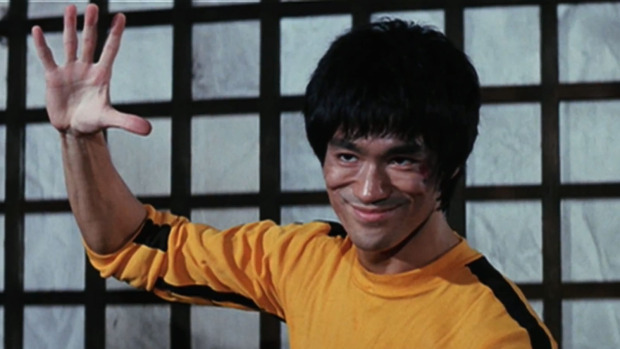
The following excerpt originally appeared in The Art of Expressing the Human Body by Bruce Lee, originally published in 1998. The “by Bruce Lee” credit is a bit of a misdirect too. The book was compiled and edited by John Little, a writer, bodybuilder and martial artist who was given access to Lee’s personal notes, letters, diaries and training logs by the Bruce Lee estate. Large chunks of the book are visible using Google Books. The excerpt is particularly interesting to me as it is a quotation from prolific screenwriter Stirling Silliphant who was responsible for (amongst many, many other things) In the Heat of the Night, The Enforcer, The Killer Elite and Shaft in Africa. Here it is:
“Bruce had me up to three miles a day, really at a good pace. We’d run the three miles in twenty-one or twenty-two minutes. Just under eight minutes a mile. So this morning he said to me “We’re going to go five.” I said, “Bruce, I can’t go five. I’m a helluva lot older than you are, and I can’t do five.” He said, “When we get to three, we’ll shift gears and it’s only two more and you’ll do it.” I said “Okay, hell, I’ll go for it.” So we get to three, we go into the fourth mile and I’m okay for three or four minutes, and then I really begin to give out. I’m tired, my heart’s pounding, I can’t go any more and so I say to him, “Bruce if I run any more,”—and we’re still running—“if I run any more I’m liable to have a heart attack and die.” He said, “Then die.” It made me so mad that I went the full five miles. Afterward I went to the shower and then I wanted to talk to him about it. I said, you know, “Why did you say that?” He said, “Because you might as well be dead. Seriously, if you always put limits on what you can do, physical or anything else, it’ll spread over into the rest of your life. It’ll spread into your work, into your morality, into your entire being. There are no limits. There are plateaus, but you must not stay there, you must go beyond them. If it kills you, it kills you. A man must constantly exceed his level."

Wednesday, May 29, 2013

The Full Clip #4

Face front, true believers! It’s time for a fourth fulsome frolic through the fascinating fresh features lurking in my open browser tabs. Have at thee!


Michael Shannon is great. That isn't up for discussion. It’s an unassailable fact. He turns out totally committed and utterly compelling performances Every Single Time. He’s the kind of actor that gets called “intense” a lot. It might be the jawline. Or the eyes. Or maybe just a lack of imagination on the part of journalists. Take your pick. (He’s also the only reason I persisted with the turgid, unfocused Boardwalk Empire for as long as I did). Turns out that he’s a damn fine and very funny interviewee too. Here he is waxing deadpan on the promotional circuit for The Iceman, firstly talking to Kase Wickman at Film.com (in which he mentions the woefully-underseen and entirely wonderful Grand Theft Parsons, which You Absolutely Must See) and then with Andrew Goldman for the New York Times.

Sticking with the New York Times, next up is the awkwardly-titled Brook Barnes article "Solving Equation of a Hit Film Script, With Data", the depressing tale of Vinny Bruzzese, his company Worldwide Motion Picture Group and the script evaluation work they do in Hollywood - applying flaky statistical data and analysis to calculate the likelihood that a script can become a successful movie. If you want to know why so much Hollywood “product” is increasingly bland, you really need to read this. Here’s an Orwellian taster, as laughably absurd as it is ever-so-slightly chilling: "Bowling scenes tend to pop up in films that fizzle...Therefore it is statistically unwise to include one in your script."


2013 marks the 50th Anniversary of my beloved Doctor Who. To celebrate the good Doctor’s adventures in Time and Space, the BFI are holding a yearlong season of monthly events, commemorating a Doctor a month. In April, it was the turn of the Fourth Doctor Tom Baker, an actor who didn't actually seem to play the Doctor. He just was the Doctor. The on-stage Q&A alongside Louise Jameson and Philip Hinchcliffe (following a screening of The Robots of Death), was just as rambling, odd, charming and witty as you would expect from both him and his Doctor. Click through for over half an hour of glorious video from the event.


Daffy Duck, Barney Rubble, Porky Pig, Speedy Gonzales, Yosemite Sam. Mel Blanc's voice was a fundamental part of all of them. But one of them was a fundamental part of Mel Blanc more than any of the others - the wascally wabbit who always forgot to take that left turn at Albuquerque. Which is why, one day in 1961, Bugs Bunny saved Mel Blanc's life. And if you want to know how, you're going to have to click through to this article at Open Culture.

Thursday, May 02, 2013

The Full Clip #3


It’s that time again. Here we go with another whirlwind whisk through my browser history. Onwards!
Oh, Cineworld, what have you done? Thanks to Craig Skinner for bringing this to my attention via Twitter earlier today, and for posting a PDF of this fantastically ill-conceived questionnaire on his website. On one level, it’s difficult to take it too seriously, due to mangled grammar and rudimentary spelling mistakes. But that’s not the real problem. The real problem is the pernicious casual everyday sexism dripping off the questions from Question Six onwards. I can’t believe an adult wrote these questions. The questions sound more like the sweaty ravings of a hormonal, priapic teenage boy. I could just shake my head and laugh, but someone signed off on this atrocity and gave the all-clear to send out a laughable, inappropriate and skeevy selection of questions to a substantial user base. I’m now just counting the minutes until Cineworld apologise whilst blaming an unpaid intern who no longer works for the organisation. Seriously, Cineworld, you done fucked up Big Time.

Whilst I’m on the subject of professionalism or the lack thereof, there’s a great piece by Paul Tucker at The Quietus on the way that thoughtful, detailed articles are routinely cannibalised by lesser writers (or, if we’re being honest, “content monkeys”), who cynically strip them down to tweet-length soundbites in a brutally reductive way just so that they can chase click-throughs and page impressions. Killer line of the article for me: “journalism without a basic and objective curiosity is not journalism at all.”
That’s more than enough of me railing against bad writers. Let’s talk about a good writer instead. Tying in with the release of Iron Man Three, Kyle Buchanan at Vulture looks back at the scripts of Shane Black, in particular his unorthodox, inventive, playful scene-descriptions. “The most famous thing Black ever wrote isn't even a piece of dialogue ... instead, it's this description of a setting from Lethal Weapon, structured as a muscular meta boast that practically defined the swinging-dick attitude of mid-eighties action movies”

From Thailand, here’s an astonishing sweded Iron Man Three trailer:


I can’t really say too much about this next link without blowing any surprises if you don’t already know the story. But it’s good. Really good. Trust me. At The Daily Dot, Kevin Morris tells the strange tale of the mysterious Yuri Gadyukin and The Greatest Movie That Never Was.
At The Atlantic, Thomas Pierce’s beautiful short story The Critics, about a father, a daughter and a movie review website.

For the Los Angeles Review of Books, Howard Chaykin writes a terrific obituary for comics maestro Carmine Infantino.

Wednesday, April 10, 2013

Spring Break Forever, Bitches


“Life is like arriving late for a movie, having to figure out what was going on without bothering everybody with a lot of questions, and then being unexpectedly called away before you find out how it ends” - Joseph Campbell

“Just pretend it's a video game. Like you're in a fucking movie.” - Brit (Ashley Benson) in Spring Breakers

I think that the American mythologist Joseph Campbell would have loved Harmony Korine’s Spring Breakers a lot.

This has been said many times before, but it bears repeating: Whatever you bring to a film has a direct correlation to whatever you take away from it. That isn’t as simple as it sounds. Contemporary mainstream commercial filmmaking is machine-tooled and polished to conspire against that. “Product” is burnished to an inoffensive sheen, with all subtlety and ambiguity sanded off to ensure that the widest possible audience can gasp at the same stunts, laugh at the same jokes, jump at the same scares. Everyone is supposed to feel the same thing at the same time for the same reasons. Its all urtext, no subtext, with a production entity as the primary authorial voice, and writers and directors drafted in and discarded as little more than skilled technicians.

None of that applies to Spring Breakers. For every viewer, there’s a different response and opinion. Lots of people like it, but they rarely like it for the same reasons. And lots of people hate it but, again, for a plethora of different reasons. From browsing various appraisals of the film, people are obviously seeing very different things. Like I said, whatever you bring to a film has a direct correlation to whatever you take away from it.


“Life is without meaning. You bring the meaning to it. The meaning of life is Whatever you ascribe it to be. Being alive is the meaning.” - Joseph Campbell

“I think that's the secret to life - being a good person.” - Brit (Ashley Benson) in Spring Breakers

“Your life is the fruit of your own doing. You have no one to blame but yourself.” - Joseph Campbell

I love Spring Breakers for a lot of reasons. Because it’s Miami Vice and Cape Fear and The Wizard of Oz. Because in the same way that Korine's previous feature Trash Humpers was a woozy, discomfiting nightmare, Spring Breakers is an intoxicating, mesmerising dream. Because it also reflects and refracts ideas that Korine seeded in the film before that - Mister Lonely. Like that film’s celebrity impersonators, our four heroines in Spring Breakers are looking for a place where they can all belong. Where they can try on another skin to see if it fits. To see if it makes them more comfortable. To see if it makes them happy or free. And at the same time, the girls are also like Mister Lonely’s skydiving nuns, jumping out of planes and holding on to the belief that if you are true of heart, God will protect you. A leap of Faith.

“We must let go of the life we have planned, so as to accept the one that is waiting for us.” - Joseph Campbell

“Faith, we're not going to let anything happen to you.” - Brit (Ashley Benson) in Spring Breakers

“The adventure of the hero is the adventure of being alive” - Joseph Campbell

“I’m so tired of seeing the same things every single day. Everybody’s miserable here because everybody sees the same things. They wake up in the same bed. Same houses. Same depressing streetlights. One gas station. The grass, it’s not even green. It’s brown. Everything’s the same and everyone’s just sad.” - Brit (Ashley Benson) in Spring Breakers


And so our four heroines follow their bliss and go on a trip to an Alien land, where they encounter James Franco playing the Wizard of Oz for the second time this year. A huckster, a coward, a blowhard, a show-off. Great and Powerful. A bullshit artist not entirely devoid of resources and tricks.

“This is the fuckin' American dream. This is my fuckin' dream, y'all!” - Alien (James Franco) in Spring Breakers

“Aren't you the great man we've been waiting for?” - Theodora (Mila Kunis) in Oz the Great and Powerful


Instead of being greeted by the welcoming songs of the Munchkins at the beginning of the Yellow Brick Road, the girls arriving in this colourful land are met by a wall of pounding electronic beats and the call-and-response rapping of Franco’s Alien. To begin with, the trip is a good trip. Hallucinatory, intense, stimulating, exciting. And decadent, phantasmagorical and overpowering. Hypnotically repetitive. But they aren't quite entirely subsumed by the dream. We can still see traces of the young girls who do handstands in dorm corridors and convenience store parking lots, belting out Britney Spears songs.

“I'm starting to think this is the most spiritual place I've ever been.” - Faith (Selena Gomez) in Spring Breakers

“I don't believe people are looking for the meaning of life as much as they are looking for the experience of being alive.” - Joseph Campbell


It doesn't take long before it becomes a bad trip. A psychedelic crisis. As the psychiatrist Stanislav Grof concluded during his investigations into altered states of consciousness, bad trips can be “exacerbated by the inexperience or irresponsibility of the user or the lack of proper preparation and environment for the trip, and are reflective of unresolved psychological tensions triggered during the course of the experience.” Just as Dorothy eventually sees the man behind the curtain, the girls soon realise how much of Alien’s swagger is just bluster and bravado.

“I'm Alien. My real name is Al, but truth be told, I'm not from this planet.” - Alien (James Franco) in Spring Breakers

“I might not actually be a wizard...” Oz (James Franco)
“Yes, but they don't know that.” Glinda (Michelle Williams) in Oz the Great and Powerful


The dream starts to sour for the girls after a night in a police lock-up, followed by a scene far more disturbing than the sight of Robert De Niro’s Max Cady forcing his finger into Juliette Lewis’s mouth in Scorsese’s Cape Fear. (A connection I made watching the movie before I noticed that Korine himself had copped to the deliberate comparison in this interview.)

Here, Alien’s rough, dark, sun-coarsened hands seem monstrous, huge and threatening as they stroke Faith’s unspoiled alabaster skin. With every caress, he seeks to cajole and soothe her, but every stroke just frightens her more and pushes her further out of the dream, until the jig is up and the Wizard’s spell is broken.

“Please come home with me.” - Faith (Selena Gomez) in Spring Breakers 

“There’s no place like home, there’s no place like home, there’s no place like home...” - Dorothy (Judy Garland) in The Wizard of Oz

“One thing that comes out in myths is that at the bottom of the abyss comes the voice of salvation. The black moment is the moment when the real message of transformation is going to come. At the darkest moment comes the light.” - Joseph Campbell


It’ll take more than unwelcome pawing from a predatory male to snap the other three girls out of their reverie. But, sure enough, one by one, the girls will awaken from the day-glo dream to dull hangovers and smudged sunrises.

“It's a wonderful, wonderful opera, except that it hurts.” - Joseph Campbell


“People say that what we're all seeking is a meaning for life. I don't think that's what we're really seeking. I think what we're seeking is an experience of being alive, so that our life experiences on the purely physical plane will have resonance within our own innermost being and reality, so that we actually feel the rapture of being alive. That's what it's all finally about.” - Joseph Campbell


Friday, April 05, 2013

Roger Ebert 1942 - 2013


This is my happening and it freaks me out.

If you've ever incurred my wrath, then at some point I've probably told you that “You will drink the black sperm of my vengeance.” You can thank Roger Ebert for that one.

At the moment, I have no words. So I’m getting out of the way, and posting just a small selection of my favourite bits of Roger Ebert. See you at the movies.

“The Muse visits during the act of creation, not before. Don't wait for her. Start alone.”

“Your intellect may be confused, but your emotions will never lie to you.”


"When they stop making movies like Infra-Man, a little light will go out of the world."

"Just write, get better, keep writing, keep getting better. It's the only thing you can control." 

"Pearl Harbor is a two-hour movie squeezed into three hours, about how on Dec. 7, 1941, the Japanese staged a surprise attack on an American love triangle." 


"When I write, I fall into the zone many writers, painters, musicians, athletes, and craftsmen of all sorts seem to share: In doing something I enjoy and am expert at, deliberate thoughts fall aside and it is all just there. I think of the next word no more than the composer thinks of the next note."

"Never marry someone who doesn't love the movies you love. Sooner or later, that person will not love you." 

“We are put on this planet only once, and to limit ourselves to the familiar is a crime against our minds.”